K-Wires, Steinmann Pins and Orthopedic Handles: Points, Threads and Torque
ZHONGJIAN TECH guide to K-wires and Steinmann pins from 0.7 to 4.8 mm, point styles and thread types plus fixed, ratchet and torque-limiting handles.
Fixation pins and the handles that drive them are the quiet workhorses of orthopedic surgery. A K-wire holds a fracture in place while it heals. A Steinmann pin provides skeletal traction or temporary fixation in larger bone. A handle turns a drill, a tap or a screw, and a torque-limiting handle stops the user from applying more torque than the procedure calls for. None of these tools is complicated, but each of them has to be ordered exactly right: the wrong diameter, the wrong point, the wrong thread or the wrong coupling wastes time in theatre and cannot be corrected on the spot. This guide explains the ZHONGJIAN TECH range of pins and handles using the catalog figures, so a buyer can order each item by its part number with confidence.
The range has two pin products and four handle products. The pins are K-Wires (Kirschner Wires) and Steinmann Pins. The handles are Fixed Handles, Ratchet Handles, Torque-Limiting and Torque Plus Handles, and Coupling Adapters. The sections below take the pins first, then the handles, and finish with the adapters that connect one to the other.
K-Wires vs Steinmann Pins
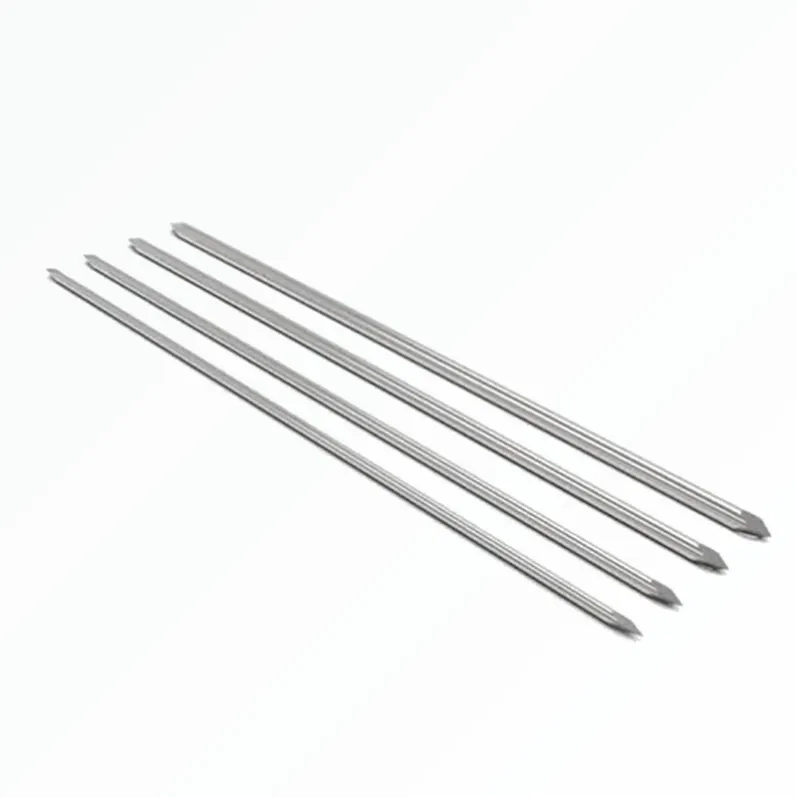
K-wires and Steinmann pins are the same kind of tool in two sizes. K-wires are the smaller of the two. Their diameters are 0.7, 0.9, 1.1, 1.4 and 1.6 mm, which convert to 0.028, 0.035, 0.045, 0.054 and 0.062 inches. Their lengths are 4 inches or 102 mm, 5 inches or 127 mm, 6 inches or 152 mm, and 9 inches or 229 mm. Steinmann pins are larger. Their diameters are 2.0, 2.4, 2.8, 3.2, 3.6, 4.0 and 4.8 mm, which convert to 5/64, 3/32, 7/64, 1/8, 9/64, 5/32 and 3/16 inches. Their lengths are 4 inches or 102 mm, 6 inches or 152 mm, 9 inches or 229 mm, and 12 inches or 305 mm.
The size difference is the main difference. A K-wire at its largest, 1.6 mm, is still smaller than a Steinmann pin at its smallest, 2.0 mm. Lengths overlap at 4, 6 and 9 inches, but only Steinmann pins are offered at 12 inches, and only K-wires are offered at 5 inches. A buyer should therefore check both diameter and length against the family, not against the pin range as a whole. Ordering a 5-inch Steinmann pin or a 12-inch K-wire would be ordering a size that does not exist.
Both families use the same part-number logic. A K-wire part number begins with KQ, followed by the diameter code, the point code, the length code and the thread letters. A Steinmann pin part number begins with SQ and follows the same pattern. KQ-07104NT is a 0.7 mm K-wire, Double Trocar point, 4 inches long, smooth. KQ-16409FT is a 1.6 mm K-wire, Trocar One End plus Plain End, 9 inches long, fully threaded. SQ-20104NT is a 2.0 mm Steinmann pin, Double Trocar point, 4 inches long, smooth. SQ-48112FT is a 4.8 mm Steinmann pin, Double Trocar point, 12 inches long, fully threaded. The point code in these part numbers is a single digit: Double Trocar is point code 1, and Trocar One End plus Plain End is point code 4. So KQ-07104NT reads as diameter 07, point 1, length 04, and SQ-48112FT reads as diameter 48, point 1, length 12.
Point Styles
The point is the working end of the pin, and the catalog lists nine point and shank combinations. They are Double Trocar; Trocar One End plus Three Side Shank; Diamond One End plus Three Side Shank; Trocar One End plus Plain End; Diamond One End plus Plain End; Double Diamond; Diamond plus Trocar; Trocar One End plus Round End; and Diamond One End plus Round End. Not every combination is tabulated for both families, and that distinction matters when ordering.
For K-wires, five point combinations are tabulated: Double Trocar; Trocar One End plus Plain End; Diamond One End plus Plain End; Double Diamond; and Diamond plus Trocar. The Three Side Shank and Round End combinations are shown on the catalog's overview page only, with no tables behind them, so their availability should be confirmed before they are listed as orderable variants. For Steinmann pins, seven point combinations are tabulated: Double Trocar; Trocar One End plus Three Side Shank; Diamond One End plus Three Side Shank; Trocar One End plus Plain End; Diamond One End plus Plain End; Double Diamond; and Diamond plus Trocar. The Round End combinations are not tabulated for Steinmann pins either.
A trocar point and a diamond point are different shapes, and the catalog keeps them distinct. A Double Trocar pin has a trocar point at both ends. A Double Diamond pin has a diamond point at both ends. A Diamond plus Trocar pin has one of each. A Trocar One End plus Plain End pin has a trocar point at one end and a plain end at the other. The point style should be confirmed with the surgical team before ordering, because it is fixed once the pin is made and cannot be changed in theatre.
Thread Types and Suffixes
Thread type is the second choice after point style, and it is the same across both pin families. NT means Smooth, with no thread. ST means Short Partially Threaded, with thread over part of the pin. FT means Full Threaded, with thread along the full length. The thread letters are the last two letters of the part number, before any suffix: NT, ST or FT. A smooth pin and a fully threaded pin of the same diameter, point and length are different part numbers, and they are not interchangeable.
Two suffixes apply to both families. Add R to the end of the part number for a Round End, on a Plain End part number. Add S to the end of the part number for a sterile pin. So KQ-07104NT is a smooth K-wire, and KQ-07104NTS would be the same pin supplied sterile. The suffixes should be confirmed at the ordering stage, because a non-sterile pin cannot be used where a sterile one is required, and a round end cannot be added after the pin is made.
Fixed Handles
Fixed handles are the simplest handles in the range: a grip, a body and a coupling, with no moving parts. The catalog lists the part numbers for Fixed Handles in the 105 series, with overall lengths from 109 to 196 mm. Most are cannulated, meaning they have a hollow channel through them, and two are Cap types, which are non-cannulated.
The listed Fixed Handles include 105-13-00, a Mini AO Cap at 119 mm; 105-11-00, an AO Cap at 116 mm; 105-24-00, an AO Cap in phenolic at 116 mm with a 73 mm grip; 105-25-00, an AO Cannulated handle in phenolic at 155 mm with a 113 mm grip; 105-23-00, an AO Cannulated handle at 138 mm with a 95 mm grip; 105-22-00, an AO Cannulated handle at 133 mm with a 90 mm grip; 105-32-00, an AO Cannulated handle in silicone at 109 mm with a 79 mm grip; 105-18-00, an AO Cannulated handle in silicone at 130 mm; 105-14-00, a Hudson Cannulated handle at 112 mm; 105-31-00, a 1/4 SQ Large Cannulated handle at 158 mm; 105-19-02, a Jacob Chuck Large Cannulated handle at 196 mm; 105-20-00, a 3/16 SQ T-grip at 110 mm tall and 92 mm long; 105-26-00, an AO T-bar at 80 mm tall and 75 mm long; and 105-21-02, a Jacob Chuck Cannulated T-grip at 114 mm tall and 121 mm long. The product page for Fixed Handles lists all of these part numbers with their lengths and grip details.
The handles share a common design described in the catalog. Their shape is ergonomic, to reduce fatigue and improve grip, and their body is aluminium alloy, to reduce weight and enhance durability. Grip styles are numbered 1 to 14: silicone grips numbered 1 to 8 and 10, with lengths from 50 to 114 mm and diameters from 22 to 66 mm, in black, blue, orange and green; and phenolic and Radel grips numbered 11 to 14, with lengths from 73 to 113 mm and diameters from 20 to 34 mm. Both axial handles and T-handles are shown. Female coupling connectors listed are Mini AO, Push AO 1, 2 and 3, Pull AO, 3/16 SQ, 1/4 SQ, Tri Lobe, Small Hudson, Large Hudson and Jacob Chuck. Male coupling connectors listed are Mini AO, AO, Tri Lobe 3/16, Tri Lobe 1/4, 3/16 SQ, 1/4 SQ, Small Hudson, Large Hudson and Hudson. The coupling on the handle must match the coupling on the instrument it drives.
Ratchet Handles
Ratchet handles add a three-way ratcheting mechanism to the fixed handle. The mechanism has three positions — forward, reverse and locked — and it allows rotation without stopping to adjust the position of the wrist. All of the ratchet handles listed in the catalog are cannulated.
The range is organised by size. Small ratchet handles are 105-05-00 and 105-30-00, AO Small Ratchet Cannulated Cap handles at 132 mm with a 78 mm grip. Medium ratchet handles are 105-29-00 and 105-03-00, AO Medium Ratchet Cannulated handles at 146 to 147 mm with a 105 mm grip, and 105-01-00 and 105-17-00, AO Medium Ratchet Cannulated handles in silicone at 144 to 145 mm. Large ratchet handles are 105-19-00 and 105-27-00, AO Large Ratchet Cannulated handles at 167 to 176 mm with a 130 mm grip; 105-08-00, a Hudson Large Ratchet Cannulated handle at 182 mm; 105-07-00, a 1/4 SQ Large Ratchet Cannulated handle at 85 mm with a compact head; 105-06-00, a Tri-Lobe Large Ratchet Cannulated handle at 164 mm; and 105-09-00, a 1/4 SQ Large Ratchet Cannulated handle at 164 mm. Large Jacob Chuck ratchet handles are 105-19-01 at 203 mm and 105-21-03, a T-grip at 166 mm and 114 mm tall. Large T-grip ratchet handles are 105-28-00, a Pull AO handle at 119.5 mm and 114 mm tall; 105-04-00, a Tri-Lobe handle at 117 mm; 105-21-00, a Hudson handle at 125 mm; 105-21-01, a 1/4 SQ handle at 117 mm; and 105-12-00, an AO handle at 128 mm.
The choice between a fixed handle and a ratchet handle is a choice about how the handle will be used. A fixed handle turns only when the hand turns. A ratchet handle turns in one direction and slips in the other, so the hand can return to its starting position without reversing the instrument. That is the practical meaning of the forward, reverse and locked positions: forward drives the instrument, reverse releases it, and locked holds it. A buyer who needs that function should order a ratchet handle; a buyer who does not should order a fixed handle, which is simpler and has no mechanism to maintain.
Torque-Limiting and Torque Plus Handles
Torque-limiting handles add a second function: they limit the torque applied to a screw or instrument. The Zhongjian Tech torque-limiting range covers 0.15 to 15 N·m, calibrated to plus or minus 10 percent accuracy for torque from 0.5 to 15 N·m. The catalog gives that range only. It does not print an individual torque value for each part number, so no per-part torque value is published on the Zhongjian Tech site. A buyer should confirm the torque value per part before ordering, and should not assume a value from the range alone.
The listed torque-limiting handles are 106-05-00, a 1/4 SQ Cannulated Torque handle with a T-grip at 136 mm, 114 mm tall; 106-12-00, a Hudson Cannulated Torque handle with a T-grip at 145 mm, 114 mm tall; 106-00-00, a Mini AO Torque Cap at 120 mm with an 86 mm grip; 106-01-00, an AO Torque Cap at 118 mm with an 86 mm grip; and 106-13-00, an AO Pull Cannulated Torque handle at 118 mm with an 86 mm grip.
Torque Plus handles combine the two functions above: they are two-in-one handles that combine ratchet and torque limiting. The listed Torque Plus handles are 106-02-00, an AO Ratchet Torque Cap at 140 mm, and 106-04-00, a 1/4 SQ Ratchet Torque Cap with a T-grip at 146 mm, 114 mm tall. A buyer who needs both ratcheting and torque limiting in one handle should order a Torque Plus handle. A buyer who needs torque limiting only should order a torque-limiting handle, and a buyer who needs ratcheting only should order a ratchet handle.
The catalog gives one test example for torque-limiting drivers: a 1.13 N·m torque limiting driver test, with total use of 75 clicks per cycle multiplied by 80 cycles, equal to 6,000 clicks. That is a test example, not a specification for all handles, and it is presented as such on the ZHONGJIAN TECH site. It should not be read as a torque value, a life rating or a limit that applies to every torque handle in the range.
Coupling Adapters
Coupling adapters connect a handle with one coupling to an instrument with another. Without the right adapter, a handle and an instrument with different couplings cannot be used together. The ZHONGJIAN TECH range has six adapters, all in the 105 series, with lengths from 55 to 65 mm and a body diameter of 20 mm, except for 105-54-00, whose body diameter is 25 mm.
The six adapters are 105-50-00, AO to 3/16 Tri-Lobe, 55 mm; 105-51-00, AO to 1/4 SQ, 60 mm; 105-52-00, 1/4 SQ to 3/16 Tri-Lobe, 58 mm; 105-53-00, Tri-Lobe to 1/4 SQ, 56 mm; 105-54-00, 1/4 SQ to Hudson, 65 mm with a 25 mm body; and 105-55-00, Hudson to 1/4 SQ, 58 mm. A buyer ordering an adapter should state both ends — the coupling on the handle side and the coupling on the instrument side — and check them against this list. An adapter that matches one end but not the other does not solve the problem.
Putting a Set Together
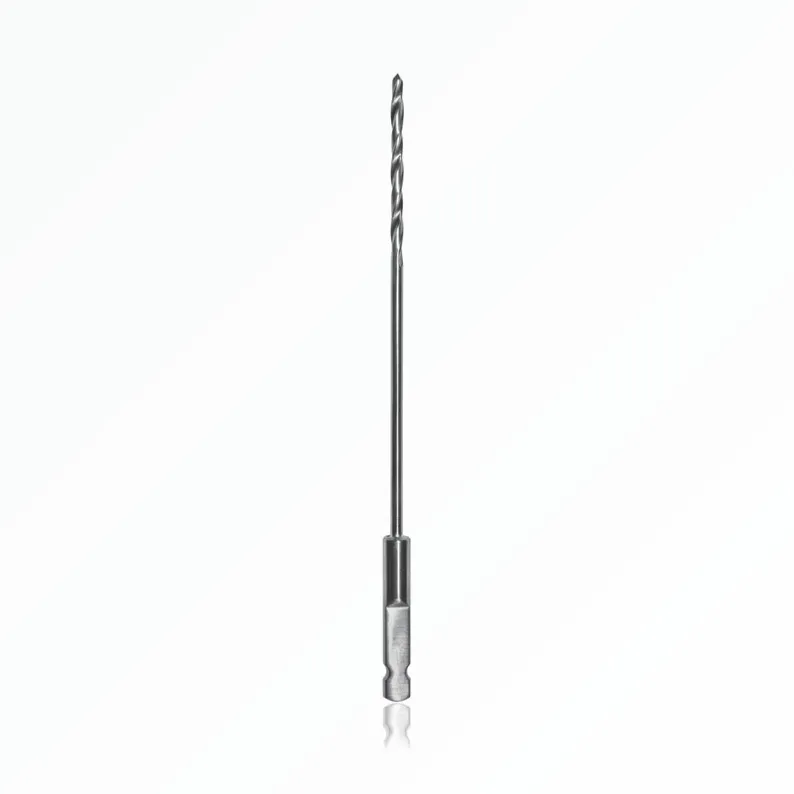
Pins, handles and adapters are ordered together more often than they are ordered alone, and it helps to check the set as a whole before ordering. First, confirm the pin: K-wire or Steinmann pin, diameter, length, point style and thread type, with the R and S suffixes if a round end or sterile supply is required. Second, confirm the handle: fixed, ratchet, torque-limiting or Torque Plus, and the coupling it carries. Third, confirm the adapter, if the handle coupling and the instrument coupling differ. Fourth, confirm the drill that goes with the set, if one is needed: the ZHONGJIAN TECH drill range, including Twist Drills - AO Quick Connect, is listed alongside the pins and handles, and the coupling on the drill should match the driver in the same way.
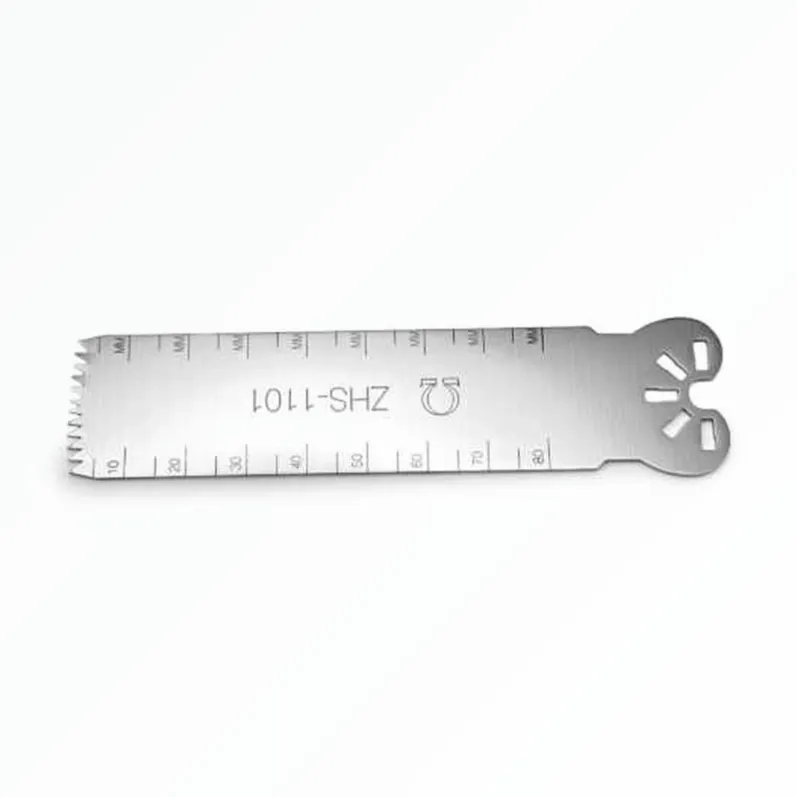
Each of those checks is a check against the catalog figures quoted in this guide. Diameter, length, point, thread, handle length, grip size, torque range and adapter length are all given in the catalog, and they are all quoted on the ZHONGJIAN TECH product pages. Where the catalog does not give a value — the torque value of an individual torque handle, the availability of a Three Side Shank or Round End K-wire, or the tooth pitch of a saw blade — the site says so and asks the buyer to confirm before ordering. That is the correct way to handle a missing figure: confirm it, rather than guessing it. A set ordered on that basis, part number by part number, is a set that arrives ready to use.